If you are a new or expecting parent shopping for nursery essentials, stepping into the swaddle aisle can feel a bit like learning a completely new language. You are confronted with terms like breathable open-weave, thermal regulation, and brushed fibers—all while trying to make a simple decision: What is the safest, most comfortable fabric to wrap my baby in?
Swaddling mimics the warm, secure pressure of the womb, helping newborns sleep longer by calming their natural startle reflex. However, because a baby’s skin is incredibly delicate and their body cannot regulate temperature the way an adult’s can, the fabric you choose matters immensely.
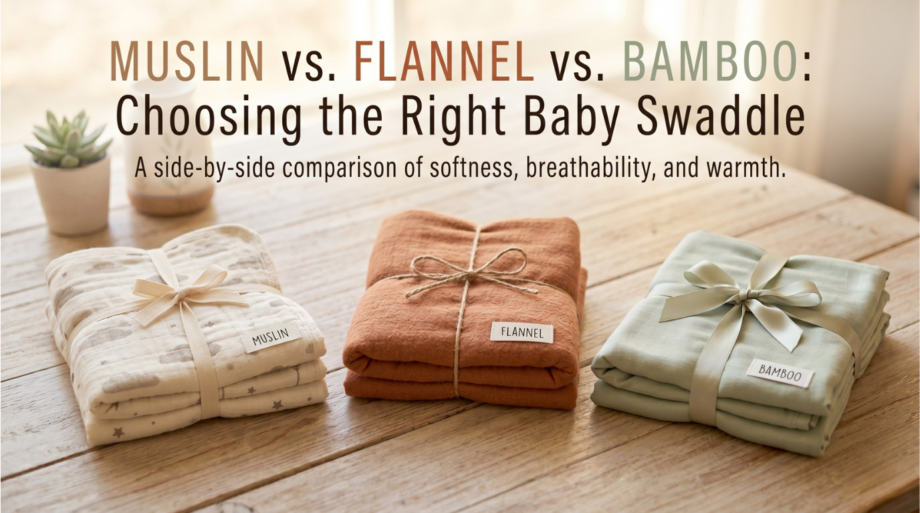
Today, we are putting the three most popular swaddle fabrics head-to-head: Organic Muslin, Traditional Flannel, and Bamboo Rayon. Let’s break down how they perform across skin safety, breathability, and durability so you can choose the perfect fit for your nursery.
1. Organic Cotton Muslin: The Gold Standard for Safety & Breathability
Muslin is not a specific material, but rather an ancient, specialized method of weaving pure cotton. It features a lightweight, loose, plain weave that creates a soft, grid-like pattern.
- The Big Benefit (Temperature Regulation): Because the weave is open and porous, air flows through it with ease. If your baby gets warm, their body heat escapes naturally instead of getting trapped against their skin. This makes muslin the safest choice for preventing overheating—a primary environmental risk factor for sudden infant death syndrome (SIDS).
- The Texture: Muslin has a unique superpower: it actually gets softer with every single wash. The loose cotton fibers relax and unfurl in the laundry, meaning a well-loved muslin swaddle feels incredibly gentle against paper-thin newborn skin.
- Best For: All-season swaddling, layering, sensitive or eczema-prone skin, and multi-use functionality (like using it as a stroller shade or nursing cover).
2. Flannel: The Cozy Option for Cold Climates
Flannel is a heavier, tightly woven cotton fabric that undergoes a “brushing” process. A mechanical brush lifts the fine cotton fibers on the surface, creating an ultra-soft, fuzzy nap that feels instantly warm to the touch.
- The Big Benefit (Insulation): Flannel is excellent at trapping air and holding onto body heat. If you live in an exceptionally cold climate or keep your nursery very cool during the winter, a flannel receiving blanket provides cozy insulation.
- The Trade-off: Because the weave is dense, it lacks breathability. If the room warms up, flannel cannot release heat efficiently, which can quickly lead to sweating and heat rash on a newborn’s sensitive chest and neck folds. It also has very little natural “give,” making it trickier to achieve a snug, comfortable swaddle stretch.
- Best For: Peak winter weather, cold climates, or outdoor stroller walks on chilly days.
3. Bamboo Rayon: The Ultra-Smooth Silk Alternative
Bamboo swaddles are made by chemically processing bamboo plant stalks into a smooth cellulose fiber, creating a fabric known as bamboo rayon or viscose.
- The Big Benefit (Smoothness & Drape): Bamboo is incredibly silky, cool to the touch, and drapes beautifully. It feels luxurious and offers a high level of natural elasticity, making it very easy to wrap tightly around a wiggly baby.
- The Trade-off: While bamboo is soft, it is a delicate fabric that requires meticulous care. It is prone to pilling (forming tiny fuzz balls) in the wash, can easily snag on baby velcro or zippers, and tends to lose its shape or stretch out over time. It also takes significantly longer to air dry compared to lightweight cotton fabrics.
- Best For: Warm summer days or parents who prefer an ultra-smooth, silky texture over a classic fabric feel.
The Head-to-Head Comparison
To help you decide which fabric belongs in your diaper bag and nursery drawers, here is how they stack up at a glance:
| Feature | 100% Organic Muslin | Traditional Flannel | Bamboo Rayon |
| Breathability | Excellent (Open weave prevents overheating) | Low (Dense weave traps heat) | Moderate to High (Cool to the touch) |
| Skin Friendliness | Hypoallergenic (Natural fibers, no synthetic buildup) | Good (Soft, but can trap sweat) | Very Smooth (Low friction, but chemically processed) |
| Durability | Maximum (Gets softer with every wash; holds shape) | High (Sturdy, but can stiffen over time) | Delicate (Prone to pilling and snagging) |
| Natural Stretch | Perfect (Loose weave stretches diagonally) | Very Stiff (Rigid structure) | High Stretch (Can stretch out over time) |
The Verdict: Which One Wins?
While all three fabrics have a place in baby care, 100% Organic Cotton Muslin consistently emerges as the most practical, safe, and versatile choice for everyday newborn swaddling. Its unmatched breathability gives parents peace of mind regarding temperature safety, while its incredible durability ensures that a small collection of high-quality blankets will last through infancy and beyond.
If you are building your registry, a smart strategy is to stock up on 3 to 5 premium muslin swaddles as your daily workhorses, keeping one flannel blanket tucked away just in case of a rainy, cold winter day.
