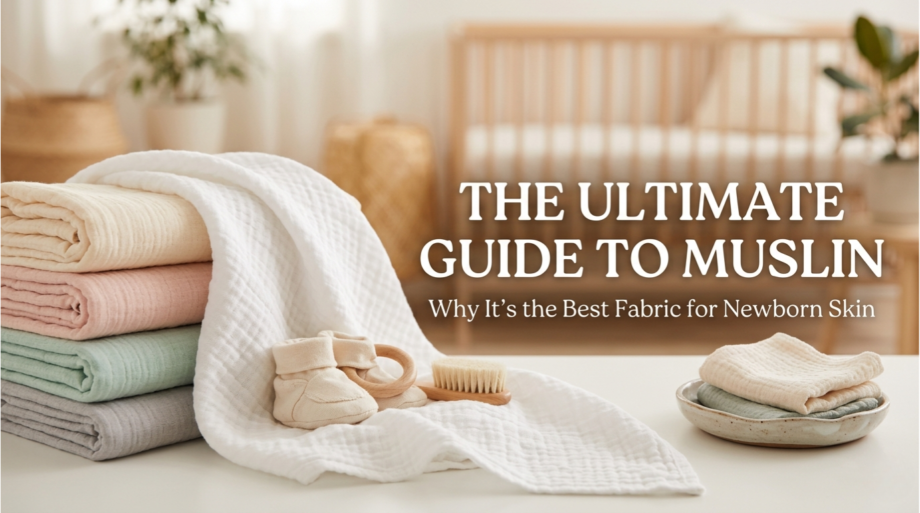
Bringing a newborn home changes everything—including how you look at a simple laundry label. Suddenly, phrases like “100% synthetic” or “chemical dyes” feel a lot more intimidating when you’re looking at your baby’s delicate, paper-thin skin.
If you’ve been building your registry or browsing nursery essentials, you’ve likely seen the word muslin everywhere. But what makes this ancient fabric the gold standard for modern baby care?
Let’s dive into the science behind muslin and why it is uniquely suited to protect, soothe, and comfort your newborn’s skin.
What Exactly is Muslin?
Muslin isn’t a specific type of plant or chemical fiber; it is a premium method of weaving cotton that dates back thousands of years. It is a lightweight, plain-weave cotton fabric that is exceptionally fine and open.
Unlike standard cotton sheets or dense flannel, muslin is woven with a deliberate, loose grid. This creates an incredibly pliable, breathable cloth that stretches gently without the need for synthetic elastic.
4 Reasons Newborn Skin Needs Muslin
A newborn’s skin is up to 30% thinner than adult skin. It loses moisture faster, absorbs environmental substances more easily, and is highly prone to chafing and irritation. Here is why muslin acts as the perfect protective barrier:
1. It Eliminates the Risk of Overheating
Newborns cannot regulate their body temperature the way adults do. They don’t sweat efficiently, which means heavy, tightly woven blankets can trap body heat and cause rapid overheating—a known risk factor for SIDS (Sudden Infant Death Syndrome).
Because of muslin’s open, breathable weave, air flows freely through the fabric. If your baby gets warm, their body heat escapes naturally, keeping them safely insulated but never sweltering.
2. It Actually Gets Softer with Every Wash
Most commercial baby fabrics rely on chemical softeners that wear off after a few spins in the washing machine, leaving the cloth stiff and scratchy.
Muslin does the exact opposite. Because of its loose construction, the cotton fibers relax, unfurl, and soften every single time they hit the water. A muslin swaddle or washcloth that you use for the fiftieth time will feel significantly gentler against your baby’s skin than it did on day one.
3. It Prevents Friction and Heat Rash
Because a baby’s skin moisture barrier is still developing, friction from stiff fabrics can easily cause micro-tears, leading to dry patches, eczema flare-ups, or heat rash.
Muslin has a natural, lightweight texture that glides smoothly over skin without dragging. Its high absorbency also means it quickly wicks away drool, milk spit-up, or sweat before it can sit on the skin and cause irritation.
4. Natural and Hypoallergenic
When crafted from pure, organic cotton, muslin is inherently hypoallergenic. It doesn’t trap dust, dander, or laundry residues the way high-pile plush blankets or synthetic fleeces do, making it incredibly safe for babies with sensitive skin or prone to allergies.
The Muslin Versatility Checklist
Because premium muslin is highly durable yet lightweight, a single large muslin square rarely serves just one purpose. Parents quickly find that a high-quality muslin cloth is the ultimate Swiss Army knife of the nursery.
- The Perfect Swaddle: The natural give of the weave allows you to tuck your baby snugly without restricting their hip movement or chest expansion.
- A Gentle Washcloth: Standard terry cloth towels can be abrasive on a newborn’s face. A layered muslin washcloth cleans effectively while respecting the skin barrier.
- The On-the-Go Nursing Cover: Because it breathes, draping a muslin cloth over yourself and your baby during a feeding provides privacy without creating a hot, stuffy pocket for the baby.
- The Stroller Shade: Tucking a muslin cloth over the stroller canopy blocks direct sunlight while allowing fresh air to circulate perfectly.
The Wash & Care Golden Rule: To keep your muslin pieces in heirloom condition, wash them on a gentle cycle with cold water and a mild, plant-based detergent. Skip the fabric softeners completely—the weave doesn’t need them, and your baby’s skin certainly doesn’t either. Tumble dry on low or line dry for that classic, crinkly muslin texture.
